



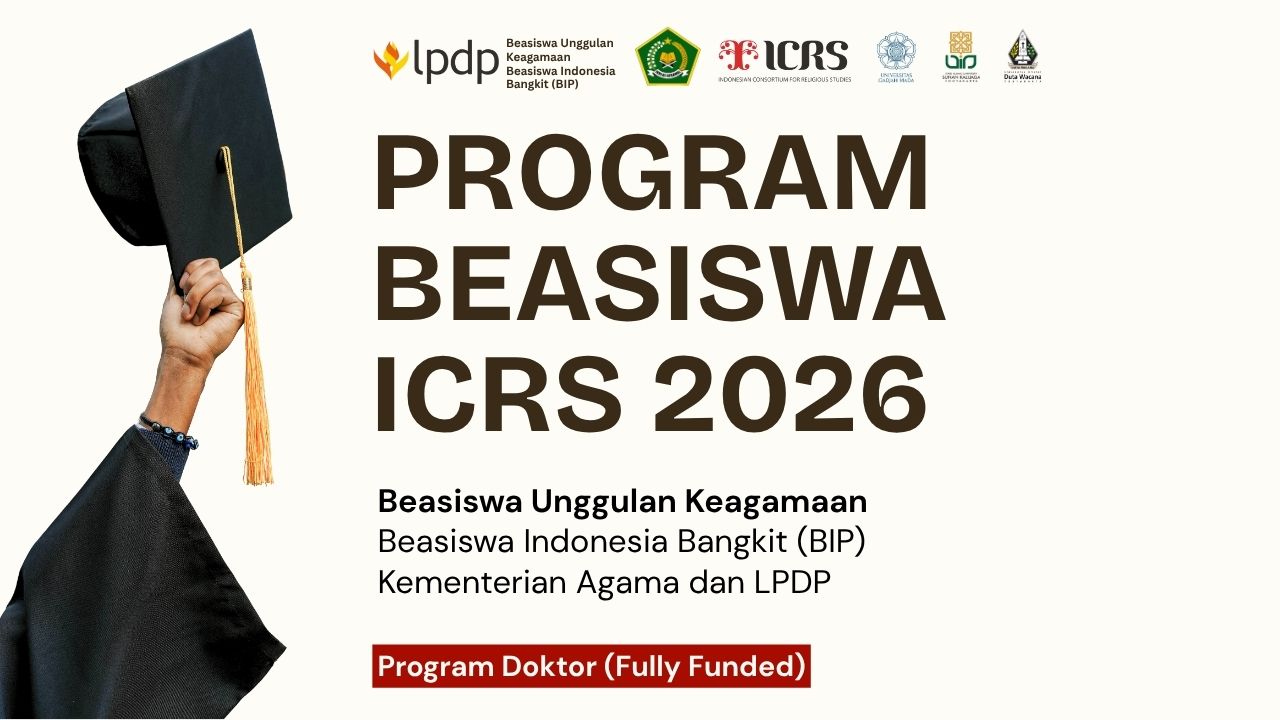
“Excellence of Religion Scholarship” is ICRS PhD Scholarship Partnership Program sponsored by the Ministry of Religious Affairs–LPDP Scholarship Program.
The Beasiswa Indonesia Bangkit (BIB) is a collaborative scholarship program between the Ministry of Religious Affairs and the Indonesia Endowment Fund for Education (LPDP), funded through the Education Endowment Fund. Within its governance framework, the Ministry of Religious Affairs—through the Center for Financing Religious Education (PUSPENMA)—acts as the program manager, ensuring policy alignment, relevance of fields of study, and the achievement of outputs and outcomes in the development of human resources on religious affairs. Meanwhile, LPDP is responsible for fund management, quality assurance, and financial accountability in accordance with the principles of the Education Endowment Fund. This synergy reflects a shared commitment to professional, transparent, and sustainable scholarship management.
In 2026, the “Excellence in Religion Scholarship” offers 15 doctoral scholarships, with five awards allocated to each of the three study programs within the ICRS consortium: IRS UGM, ITMS UIN Suka, and Theology UKDW.
Applications are open from 1 April to 30 May 2026.
Detailed information regarding the application can be found under “Application information”.
Global-Local Vision of Religious Studies
The academic vision of ICRS is grounded in a "Global-Local" perspective. This approach integrates worldwide scholarly perspectives with grounded, local realities. It examines religion as both a global phenomenon and a lived experience shaped by specific histories and cultures.
This vision highlights three interrelated areas of engagement:
1. Religion as an Interrelated Field of Study: Analyzing religion across disciplines (theology, anthropology, sociology, philosophy, political theory and so on) while remaining critically reflexive about how the category of "religion" itself is constructed.
2. Addressing Global and Local Realities: Engaging directly with pressing issues such as violence, injustice, and ecological crisis, rather than treating religion as a static object of study.
3. Power Relations Across Social Arenas: Examining how power operates in lived experience, state institutions, and within academia itself.
Three Core Themes
To achieve its goal of promoting peace, justice, and sustainability, the ICRS curriculum is organized around three main academic themes:
1. Peace
Focuses on understanding the causes of conflict and exploring pathways toward peaceful coexistence. It examines peace not only as the absence of violence but as the presence of inclusive dialogue, mutual respect, and peaceful coexistence. Research investigates conflict transformation, reconciliation, and peacebuilding.
2. Justice
Addresses questions of fairness, equality, and human dignity. It explores human rights, social justice, distributive justice, and restorative justice. Research investigates structural inequalities, discrimination, and how religion and governance can contribute to more just societies, with special attention to marginalized groups.
3. Sustainability
Emphasizes the long-term balance between human development, environmental protection, and social well-being. It encourages research on climate change, ecological degradation, and sustainable livelihoods, highlighting how religious values and local knowledge can contribute to sustainable development.
Trilogy of Transformative Approaches
The study of religion at ICRS adopts three transformative approaches:
- Community Engagement: Recognizing people and communities as knowledge holders, aligning with participatory and decolonial methodologies.
- Interdisciplinary Engagement: Dialoguing with law, environmental studies, political economy, gender studies, and cultural theory.
- Intersectoral Collaboration: Connecting academia with civil society, policymakers, activists, and religious communities.
Graduate Profiles
ICRS graduates are prepared for three primary roles:
- Educators: Able to design and teach programs integrating global scholarship with local contexts.
- Researchers: Able to investigate intersections of religion with law, politics, and environment using interdisciplinary methods.
- Community Facilitators: Able to collaborate with religious communities, leaders, and institutions to translate research into practical engagement for societal transformation.
Additional Information
Scholarship recipients are expected to commit four hours or more per week to participate in ICRS academic or scholarly enrichment activities.