




Fransiska Yohana Sri Winarsih
In 1993, Samuel Huntington published a series of articles that later became a book. He highlights the challenges posed by Islamic values to the embrace of Western liberal democracy. People tend to think that Islamic values are static and rigid. Huntington argues that Islam is naturally incompatible with democracy, which requires flexibility, adaptability, and participation.
Looking at the world’s history, Robert W. Hefner argues that establishing democracy is not an easy task for any civilization, including the West, the place where democracy was born. The West has experienced civil wars and revolutions in its effort to establish democracy, and believing that democracy is straightforward for the West is simply misguided. Anywhere in the world, democracy presents challenges and is often accompanied by conflict. Most European societies underwent democratization during periods of interaction between religion and the state. This suggests that the active involvement of religions, represented by religious institutions, in democratic life is not antithetical to democracy; the two can coexist and influence one another.
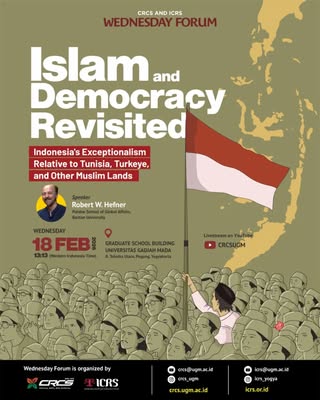
These arguments were presented at the Wednesday Forum organized by the Center for Religious and Cross-cultural Studies (CRCS) and the Indonesian Consortium for Religious Studies at Universitas Gadjah Mada on February 18, 2026, under the theme “Islam and Democracy Revisited: Indonesia's Exceptionalism Relative to Tunisia, Turkey, and Other Muslim Lands.”
In the West, the relationship between religion and democracy evolves. For instance, the role of Christianity has changed significantly as societies have become more democratic. Until the 1960s, Catholicism had not reconciled itself with liberal democracy, viewing democratic governance as contrary to religious principles. Opposition to democracy in Catholic-majority countries was harsher than in many Muslim-majority countries until 1960. There's a growing agreement among some scholars across the U.S. and Western Europe that democracy in the West is not delivered as expected despite mostly free and fair elections. By the early 2000s, with the emergence of the Arab Spring, Huntington's view that Islamic values were incompatible with democratic principles needed to be evaluated.
Arab Spring and democracy in the Middle East and North Africa
The Arab Spring was a series of protests and uprisings for democracy that began in December 2010 across the Middle East and North Africa. People were dissatisfied with dictatorships, corruption, and poverty. This movement resulted in significant changes in the governments of Tunisia, Egypt, Libya, and Yemen. With the emergence of the Arab Spring, there was great hope that democracy would spread across the Middle East, North Africa, and Muslim-majority countries. Tunisia became the first country to initiate significant political reform during the Arab Spring, which fuelled the growth of civil society movements. These civic associations played a vital role in fostering democratic values such as dialogue and civic engagement. However, Tunisia's democratic decline began in 2019 when the president assumed dictatorial powers, shutting down parliament and arresting journalists. In just two years, Tunisia transformed from a hopeful democracy to an autocracy.
Hefner agrees that, up to the 21st century, no country involved in the Arab Spring has succeeded in implementing democracy, even in its most basic form: electoral democracy. This situation seems to confirm Huntington's argument that Islamic values are incompatible with democratic principles. However, a survey keeps refuting Huntington's argument.
Democracy in Muslim-majority countries
Many Muslim-majority countries, including Indonesia, show a high aspiration for democracy, despite the mixed results of democratic governance. Surveys show that the citizens of 49 Muslim-majority countries—typically 80 to 90% of the population—believe that democracy is the best political system, even if they don't live in one. They believe that democracy is compatible with Islam and aspire to it. There are exceptions, such as Qatar, the United Arab Emirates, and Saudi Arabia; however, people in these countries do not generally express strong hostility toward democracy.
Several Muslim-majority countries effectively practice electoral democracy, including Bangladesh, Pakistan, and Turkey. However, at the top of Hefner's list is Indonesia. Indonesia stands out as the most effective Muslim-majority democracy among the 49 Muslim-majority countries. Indonesia is a well-functioning democracy. Hefner argues that the difference between Tunisia and Indonesia is that Tunisia lacks the strong pillars of civil society, as found in Indonesia.
Indonesia has numerous associations, both religiously affiliated and unaffiliated, that are crucial to democratic success. However, having numerous associations alone does not ensure democracy, as seen in Germany during the 1920s and 1930s, where civic groups adopted extremist ideologies. Hefner argues that for democracy to thrive, these associations must be supported by a democratic culture and pluralistic values.
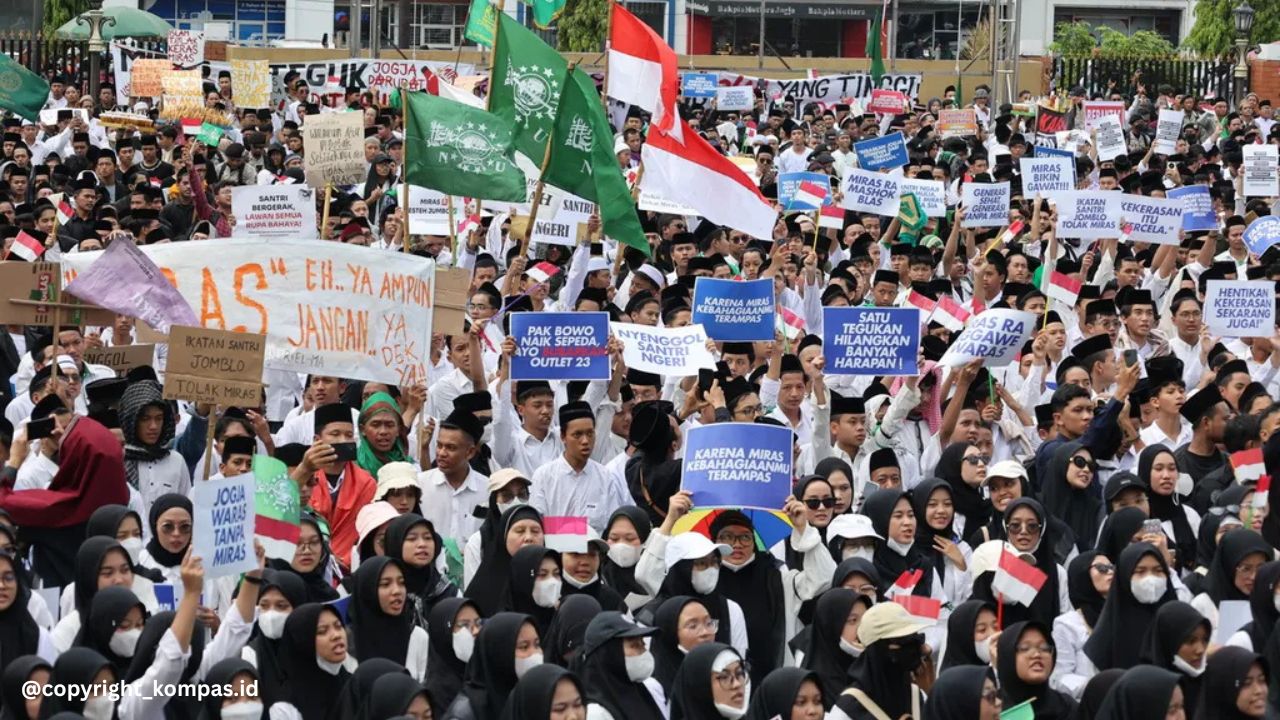
In Indonesia, two major Muslim organizations, Nahdlatul Ulama (NU) and Muhammadiyah, are key pillars of democracy. They play a significant role in the democratization process in Indonesia. These groups, being the largest Muslim civic associations globally, have promoted the idea that democracy is compatible with a multi-religious and multi-ethnic society, recognizing the diversity beyond just the Muslim majority. Muhammadiyah and NU exemplify how religious practice can engage with and evolve in a pluralistic society. These two organizations embrace a multi-religious nationalism, despite some calling for an Islamic state. This inclusiveness is a significant aspect of Indonesia's democratic strength, a quality that sets it apart from many other countries. Looking back at Indonesia's history, the founding fathers intentionally steered the nation away from becoming dominated by any single ethnic or religious group.
Some scholars studying Indonesia express concern that although Indonesia has established an electoral democracy, the gap between the rich and the poor continues to widen. One could argue that this situation is not a consequence of democracy but rather a result of the complex interactions within the political and economic spheres. Moreover, this trend of rising economic inequality is present in many countries, regardless of whether they embrace democracy or not. Hefner states that democracy does not automatically ensure income equality for everyone. This reality is separate from the principle of democracy itself.
Democracy and Sharia Law
Surveys indicate that this aspiration for democracy coexists with a strong desire to implement Sharia Law, with around 70-80% of the public supporting it. The interpretation of Sharia, or Islamic law, is crucial. Some Muslim-majority countries navigate the balance between democracy and Islamic law. Hefner states that Islamic law is not merely a state-controlled entity but rather a dynamic relationship between the state and society. This perspective suggests that efforts to codify Islamic law in a Western-style legislative framework (democracy) create laws that are as European as they are Islamic. Many scholars believe that Islamic law is not fixed but rather evolves within its social context.
Despite the diversity in faith practices, Muslims in Indonesia engage dynamically. As society modernizes, people interpret faith in many different ways. This trend has significantly shifted over the past 40 years, reflecting a growing desire for personal responsibility in faith, which fosters social cohesion and aspirations for freedom.
Although Hefner believes that democracy in Indonesia functions better than in other Muslim-majority countries, he acknowledges that the factors contributing to its vitality—such as the consensus among political elites and Islamic organizations—are limited. Although they provide some support for democracy, it has not been significant, especially over the past decade since the post-1998 reform era. The influence of Muslim mass organizations has fluctuated, and their alignment with the government has been notable.
While Muslim organizations have been relatively silent on many pressing issues, secular organizations have been more active, particularly with the ongoing situation of hundreds of activists imprisoned since September 2025 following protests. The secular organizations in Indonesia, while not highly impactful, remain vocal.
Closing
There is no single model—particularly not a so-called "Western model". Hefner argues that democracy must be actively cultivated. Democracy is a structured system that requires both rights and participation. There's a sense that democracy in Indonesia has failed to meet high expectations. To address this, we need a revitalization of civil society. Organizations such as NU and Muhammadiyah have played significant roles in democratization. We need to share Indonesia's achievements with the world and how these Muslim organizations work towards an inclusive society. Indonesia has proven that religion can be compatible with democracy, contributing to democratic norms—such as promoting social cohesion and encouraging civic engagement. In contrast, religion can also be a source of tension when religious dogma clashes with pluralism.
Indonesia stands out as a beacon for other Muslim-majority countries in democratic practice. Its unique journey offers invaluable lessons that resonate well beyond its borders, providing insights for the global community.