


Anthon Jason
In the wave of modernity, scientific knowledge, spiritual beliefs, and local traditions are often separated from each other. However, as the Master’s Program in Religious and Cross-cultural Studies (CRCS) at the Graduate School of Gadjah Mada University celebrates its 25th anniversary, it has organized an event themed “Epistemological Dialogs: Science, Religion and Tradition”. Held in the auditorium of the UGM Graduate School, this event is not only a commemoration of its silver jubilee but also a platform for in-depth reflection: from astronomy to ancestral wisdom, exploring how diverse perspectives can coexist symbiotically and even mutually reinforce one another, to realize a just, equal, and harmonious life.
Since its establishment, CRCS has viewed religion as a contested social and moral arena where justice and equality for all beings, human and non-human, must be actively pursued and institutionally realized. This orientation is rooted in the legacy of its founder, Prof. Dr. Alwi Shihab, who in 1992 developed a descriptively oriented model of religious education after attending a seminar in Carbon Dale. The seminar, which ended in deadlock due to strong mutual fanaticism among participants, spurred him to envision a more analytically robust and dialogical framework for the academic study of religion.
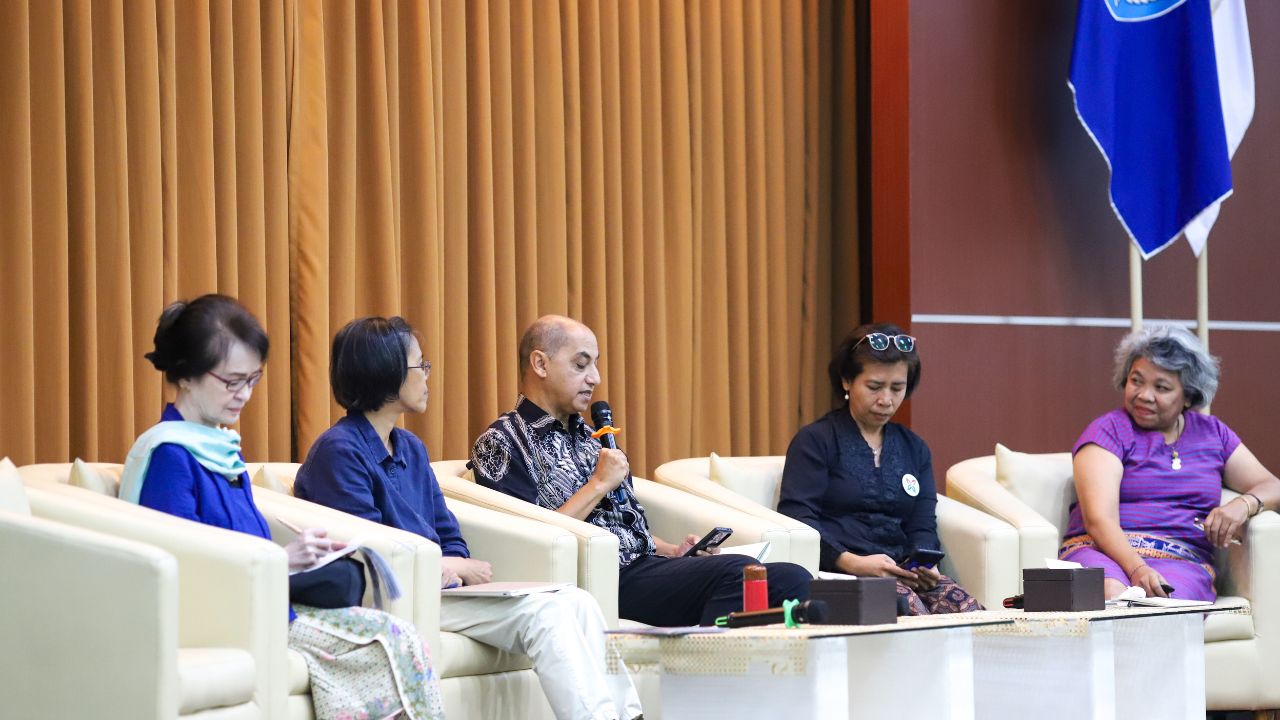
The dialog session was subsequently moderated by Dr. Zainal Abidin Bagir, who concurrently serves as Director of the Indonesian Consortium for Religious Studies (ICRS). In his introductory remarks, Dr. Zainal Abidin Bagir conceptualized the panelists as representing a distinctive intellectual trajectory: from agriculture to religious studies, then to social psychology, and culminating in astronomy and the philosophy of cosmology.
Exploring an Ethics-Based Epistemology
The panel was opened by Najiah Martiam (Jim), who shared her epistemic journey from agricultural technology and her initial desire to become a space biotechnologist, to eventually falling in love with the earth and delving into Sufism and religious studies. Jim’s inner struggle culminated in the 2010 Merapi Eruption, where tensions arose between Mbah Marijan, representing local tradition or mythology, and Mbah Surono, representing science (geophysics). Jim highlighted the narrative circulating in society at the time, which questioned whether Mbah Marijan died as a martyr (syahid) or in a state of shirk (syirik), revealing the dominance of modernist religious and scientific perspectives that tended to regard Mbah Marijan as primitive or unscientific.
From this, Jim formulates the need to understand local epistemology or ethics-based epistemology. This local knowledge is ecocentric, in which humans do not place themselves above nature but rather see themselves as part of it. Nature is regarded as something living (personhood) and as a repository of knowledge, so the relationship with nature requires unggah-ungguh (ethics). The aim of ngilmu (local knowledge) is safety or well-being (a good life). This differs from the modern approach, in which nature is often seen merely as an object created to fulfill human needs. Jim adds that in societies that still firmly uphold local epistemology, people know their life’s task (their duty) and their position in the universe, which, in turn, prompts caution in their actions to avoid violating ethical norms.
Indicting the Destructive Epistemic Rupture of the West
Dr. Risa Permana Deli, a social psychologist and director of the Center for the Study of Social Representation, deepens the dialogue by challenging the very categories of knowledge themselves. Risa asserts that the terminology ‘religion, tradition, and science’ as knowledge categories is borrowed from the history of Western civilization. Science and modernity, according to Risa, were born from an epistemological rupture in the Western Middle Ages, marked by the Cogito principle (I think, therefore I am). This principle transformed humans from sacred beings into terrestrial humans who must stand on their own, the driving force behind science and technology.
However, Risa reminds us that this epistemological rupture never occurred in the Nusantara. Western colonialism came, but it did not change the basic structure of local belief systems. As a result, Indonesia lives in a '‘double garden’' condition. The remnants of colonialism position Western knowledge (science, technology) as something formal, while all local knowledge is pushed into a clandestine current.
In real life, Risa argues, Indonesian people are neither fully modern nor fully traditional. To understand local realities, Risa invites us to look at the anthropological character of Javanese society that was once described by Clifford Geertz: yo wis ora ono opo-opo (well, then there is nothing at all). For Risa, this character may serve as a different epistemological foundation, in which the stakes of knowledge are not only about seeking truth, but about understanding ono opo kok iso ngono (what is going on so that things can be that way).
The Limits of Astronomical Knowledge and Intellectual Humility
Dr. Premana W. Premadi (Nana), a professor of astronomy at ITB, brings a cosmic perspective into the dialogue. She maps out four elements of human existence: Art (expressing), Science (finding out), Technology (serving), and Belief (belief system) (providing a foundation/grounding). Nana emphasizes that Science is tentative in nature and its domain is limited; it does not claim to know everything. Observations of the sky, such as those carried out by our ancestors through folk astronomy (for example, determining the planting season using the Orion constellation in Pranotomongso), reveal the constancy of nature that cannot be altered by humans; this gives rise to surrender or reverence toward nature.
Modern science seeks causal (cause-and-effect) relationships that can be expressed in universal form (mathematical formulas). However, Nana reminds us of Gödel’s incompleteness theorem, which states that to describe a system completely, a broader framework outside the system itself is required. This leads to the important concept of intellectual humility. In the context of cosmology, human beings find themselves in a vast universe. Science advances and increasingly shapes culture, yet the universe itself seems to have no purpose. Therefore, the challenge for humans living in a purposeless cosmos is maintaining balance while continuing to make progress. The expansion of knowledge is likened to enlarging an island, and what matters most is extending the shoreline, the boundary between what is known and what can still be questioned.
Toward A Relational and Transdisciplinary Epistemology
Prof. Dr. Karlina Supeli, from the Driyarkara School of Philosophy, concluded that the problem discussed is a profoundly fundamental existential and cultural struggle. She criticized the epistemic injustice inherited from the positivist tradition in universities, in which only knowledge that can be empirically verified and that uses the methods of the natural sciences is considered valid. This positivism marginalizes metaphysical and ethical knowledge. Karlina proposed a shift of focus from truth as representation (correspondence) to truth as coherence within a network of meanings. Knowledge, according to contemporary perspectives, is a social process that is always subject to change and constructs systems of symbolic relations to give meaning to experience.
To tap into local knowledge, Karlina offers the Standpoint Epistemology method, which requires researchers to enter from within (rather than observe from the outside) and to master local languages. She gives an example of Sundanese texts such as Sang Hyang Siksa Kandang Karsian, which show that at least three levels of knowledge are integrated into the local epistemological system: knowledge of the external world (learned from farmers/ fishermen), the synthesis of intellect and conscience (examining one’s inner self), and the relationship with the Transcendent.
In closing, Karlina emphasizes that the idea of spirituality does not have to be tied to supernatural beliefs; it can be understood as an inner experience in relation to something greater than oneself (the universe), similar to the concept of a cosmic religion proposed by Albert Einstein. This epistemological dialog serves as a reminder that true knowledge does not function merely to know in a narrow cognitive sense but to determine how we live. The essence is the courage to transcend existing disciplinary boxes, an ongoing challenge in the midst of the complexity of Nusantara’s cultures.
Conclusion: Moving Beyond Disciplinary Boundaries
Dr. Zainal Abidin Bagir closed the session by highlighting the richness of the dialogue that emerged from the epistemic journeys of the panelists. He emphasized that this discussion calls into question all existing categories of knowledge, Science, Religion, Tradition, which very often, on the contrary, limit our understanding. Dr. Zainal Abidin Bagir concluded that the true knowledge discussed by the panelists is not only used to know in a narrow cognitive sense, but aims to determine the way we live, which is reflected in the quest for salvation (Jim), for balance (Nana), or in the adoption of a certain attitude (ora ono opo-opo) (Risa). The core of the challenge raised, in line with Ms. Karlina’s proposal, is the courage to be transdisciplinary and to move beyond existing boundaries. This transdisciplinary approach, which CRCS has also long pursued, is an answer to the conflict between epistemological absolutism (the claim to a single, exclusive form of knowledge) and epistemological relativism (the claim that all are equally true).